Why F1 cars need extra cooling in Mexico
Those slots in the bodywork have a job: let cooling air out. Mexico makes that job harder.

How does an F1 car’s radiator cool the engine?
A radiator transfers heat from the engine’s liquid cooling circuit to the surrounding air. Coolant — the liquid circulating through that circuit — carries heat away from the engine; air passing through the radiator carries it away from the car.
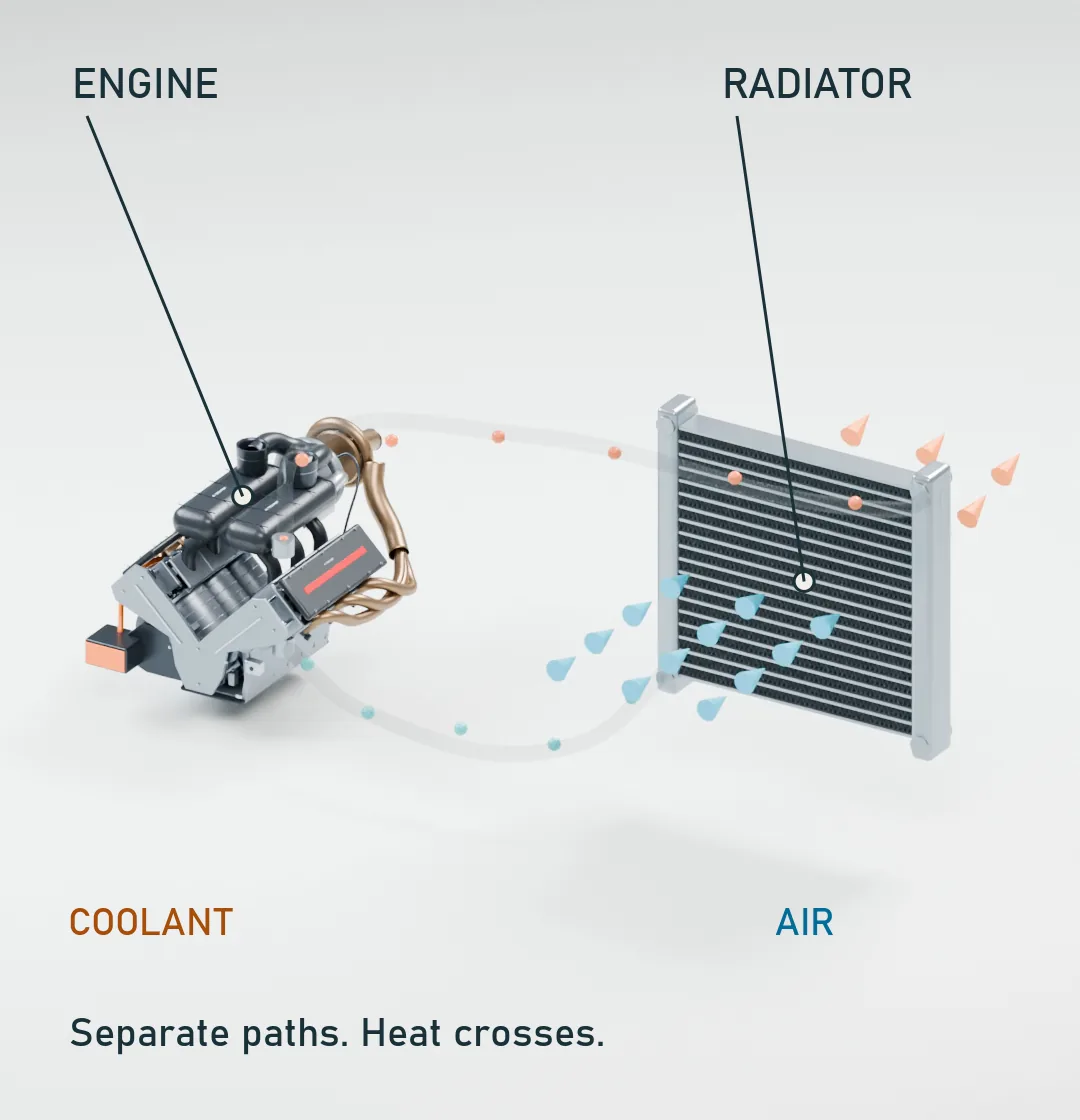
- EngineHeat passes into the circulating coolant.
- RadiatorCoolant flows through tubes; metal fins help transfer heat to the air.
- Outside airAir crosses the radiator and leaves warmer. It does not mix with the coolant.
DENSO’s radiator explanation describes this tubes-and-fins principle. Its road-car example is not an F1 installation specification. Formula 1’s sidepod glossary entry places power-unit cooling radiators within the bodywork beside the cockpit.
What are cooling louvres, and where are they?
Look for groups of slots on the upper sidepod or engine-cover bodywork. These outlet openings are different from the inlet that admits cooling air. A team can also enlarge the main bodywork exit at the rear.
That distinction helps when reading an update: a bigger outlet does not necessarily mean a bigger radiator. It can be a change to the air’s route through the existing cooling package. The 2026 Mexico submissions below describe outlet and panel changes, rather than a new radiator design.
Why does Mexico demand extra cooling?
At higher altitude, the air is less dense. For the same volume passing through a cooling duct, there is less air mass available to carry heat away. A long straight and high speed do not automatically remove that limitation.
Mercedes’ altitude explainer describes the resulting cooling challenge and why teams open up ducts and outlets. Its older power-unit and overtaking details are outside this guide’s scope; the cooling principle still explains the changes declared in 2026.
Keep temperatures under control
More opening can help enough air pass through the cooling system in demanding conditions.
Opening up has a cost
The cooling choice also affects the car’s airflow and drag. Maximum opening is not automatically the fastest setting.
Traffic matters too. In Formula 1’s 2026 Mexico preview, Williams’ strategy chief explains that expected time behind other cars feeds into the cooling choice: following can increase overheating risk. A qualifying lap in clear air is not the whole race.
What did teams declare for Mexico in 2026?
The FIA Car Presentation Submissions, document 12, issued 30 October 2026, give concrete examples. Page numbers below count the PDF cover.
McLaren: larger, reshaped louvres
Page 2 describes louvres extended forwards and reshaped to address Mexico’s power-unit cooling demands. The stated reason is circuit-specific cooling range.
Ferrari: rear exit and upper-sidepod panels
Page 7 groups the engine cover and cooling louvres under a shared explanation: a larger rear exit and additional upper-sidepod louvre panels extend cooling capacity, with an efficiency cost.
Racing Bulls: an additional option
Page 10 lists a larger rear upper exit, plus an additional forward louvre-panel option for extreme conditions. An available option is not proof that it was fitted in the race.
Explore the 2026 Mexico upgrade submissions →These are team-declared changes and aims. The submission alone does not confirm race use or a measured cooling, drag or lap-time gain.
What to watch during a race weekend
- Find the opening. Is the change an inlet, a louvre panel or the larger rear exit?
- Read the reason. Circuit-specific cooling is a different claim from a general performance upgrade.
- Check the wording. “Available” and “optional” leave a question about which configuration was actually used.
The useful question is not “which car has the most holes?” It is “what conditions is this cooling choice intended to handle?” Counting slots alone cannot tell you radiator capacity or which car will be faster.
Find McLaren’s cooling entry on the car map →F1 cooling FAQ
Is cooling only a problem in hot weather?
No. Altitude also matters. Mercedes’ temperature guide explains why warmer ambient air changes cooling needs; Mexico adds the separate challenge of low air density.
Are louvres the same as radiators?
No. A radiator transfers heat to the air. A bodywork louvre is an opening through which cooling air can leave.
Do bigger cooling openings prove that a car is overheating?
No. They can be a planned choice for the expected conditions. A declared cooling update is not evidence of a failure.
Sources and illustration notes
Sources checked on . Historical explainers support operating principles, not current regulations or exact 2026 hardware.
- DENSO: radiator tubes, fins and heat exchange (2012, reference section)
- Formula 1 glossary: sidepods and radiators
- Mercedes: high altitude and cooling (historical explainer)
- Mercedes: air temperature and cooling requirements (historical explainer)
- Formula 1: The Risk Perspective — Mexico City GP (28 October 2026)
- FIA: 2026 Mexico City GP Car Presentation Submissions (30 October, document 12; pages 2, 7 and 10)
Both images are stills from our own final cooling film. They are educational 3D concepts, not team photographs, supplier CAD, CFD or thermal measurements. F1 TECH MAP UPDATE is an independent, unofficial fan project.